
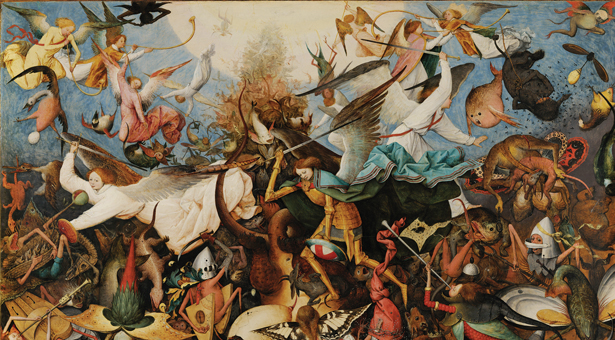
QAnon’s cryptic predictions and counter-intuitive analysis of reality read like something from a Philip K. Dick novel. In the late author’s 1974 semi-autobiographical work, Valis, the protagonist experiences a series of visions which he along with his friends interpret to reveal hidden realities of alien intelligence, political scandal, and gnostic wisdom. In fact, Dick was inspired by his own revelatory experiences—which occurred after a visit to the dentist’s office—and which contained imagery and motifs from early Christian sectarian groups that claimed to possess a secret hermeneutical key to the true nature of the cosmos.[1]
For the acolytes of QAnon, an equally “gnostic” vision of reality has been unveiled by the obscure utterances of their original online oracle. Although much debated by modern scholars,[2] the basic premise of the “gnostic” worldview, of which there were many versions in antiquity, asserts that experiential reality is not what it appears. The world we perceive is, in fact, a prison constructed by demonic powers as a means to enslave the eternal essence of the soul. Only a small spiritual elite are blessed with special revealed knowledge—gnosis—that unmasks this monumental cosmic deception.
This sort of revisionist reading of reality is very much the basis of the QAnon gospel being carried by its missionaries through the furthest reaches of the digital world. It would appear that a not-insignificant number of people—predominately Trump supporters and conservative Christians—believe (among other things) that the “real” cause of the crisis of 2020 is a subterranean religious war being waged by US soldiers against legions of Illuminati demons who torture and abuse children for the purpose of producing a highly addictive drug called adrenochrome used by liberal and Hollywood elites, such as the Clintons and Tom Hanks. The current version of QAnon builds upon the Pizzagate conspiracy theory of 2016, which alleged that senior US Democrats operated a child sex trafficking ring out of a Washington DC pizzeria, although it has now morphed into a far more expansive and eschatological narrative.[3]
One YouTube video, posted by QAnon evangelist “Blessed To Teach” constitutes a kind of Credo or Confession of Faith, punctuated as it is by a series of “I believe” statements. What does “Blessed To Teach” believe? He believes that “a cabal of secret societies has controlled the world for over 200 years” and that a deep state/shadow government is working to destroy America. However, almighty God is now intervening in history, although this is being obscured by a world media that repeats the cabal’s talking points. By the way, all religions other than Christianity are false, since salvation comes “by faith alone.” Even though George Soros is funding socialists to destroy the great nation, God has raised up an army of “Red Pill Christian Patriots” to defeat the Deep State. Beware! Infidels, for military tribunals will be established once victory is achieved under “an anointed” Donald J. Trump. Yes, you read that right! An “anointed” Donald Trump. Such a statement explicitly cast Trump as a Messiah and Christ-figure.
President Donald Trump, for his part, is also cast as a kind of radical Christian caliph, deputized by the “One TRUE Living God” to wage war against the liberal infidels covertly destroying a once great and holy nation. In the case of Trump, things are also not what they seem. The President’s tweets, far from being the shambolic ramblings of an idiotic man-child, are in fact the encoded words of a Christian oracle, the meaning of which only true believers can divine. Numerous online message boards contain the QAnonners detailed exegesis and commentary on the President’s every fragmented utterance.
The Gospel of QAnon is a curious amalgam of sex scandal, anti-government protest, survivalist mentality, science fiction, biblical religion, and military ethos. In fact, the so-called “Q” gains his authority by claiming to be a senior military officer, although the apocalyptic narrative that has evolved out of his encoded “Q-Drops” are about what you’d expect from an Evangelically funded Predator film. The “White Hat” forces are alleged to have access to advanced technologies such as “Magnetic Levitating Trains (MAGLEVS) and time travel. In combination, all of these ingredients make for a uniquely American brand of heresy and represents the “cult” of Trump in its most extreme form.
Academics, however, are not supposed to use words like “heresy” and “cult.” QAnon would more aptly be characterized as a new religious movement or millenarian sect.[4] In fact, the eschatological dimensions of QAnon are not to be underestimated. Its adherents believe themselves to be on the cusp of a pivot point in cosmic history—a “Great Awakening”—when the powerful forces of White, Christian purity (the “Red Pill Christian Patriots”) will save the great “shining city on a hill” from the dark, demonic masses that threaten to overwhelm it, also known as “the Satanics” or the “Ancient Evil Nephilim Bloodlines of Cain.” After all, are there not riots in the streets? Are people not dying in droves? Are there not earthquakes, fires, and famines? Indeed, “wars and rumours of wars”[5] is what is alleged, while the realities of climate change, mass migration, and political upheaval are all fit into a complex theological framework.
Early Christians also speculated about an overturning of their contemporary cosmo-political order using imagery of fantastic beasts, demons, and holy war. Just look at the Apocalypse of John, the final book of the New Testament. Biblical scholars have long understood that this work, like many texts written in the same genre, is more a critique of the author’s contemporary political context than a prediction of some future End of Days. It is an encoded, first-century CE critique of Roman imperial power. Nonetheless, John’s apocalypse (also popularly known as Revelations) has often been interpreted as a scriptural key to how the world will end. Early Christian readers of the work thought that the End Times were eminent, and ever since Christian groups have periodically arisen to proclaim that the Hour is at hand. Usually, these millenarian sects appear in times of crisis, and times of crisis these certainly are. In fact, the Apocalypse of John was not widely accepted into the emerging New Testament canon until well into the 4th century CE. Many early Christian leaders thought the text encouraged worrisome eschatological impulses that the institutional church found difficult to control. QAnon, for its part, is not so much a “church” (in a sociological sense) but a loosely connected network of online commentators. Even though it was birthed in a matrix of Evangelical fundamentalism[6] and Republican extremism (a phenomenon one might well describe as “American Liberty Religion”) QAnonners are under no recognizable institutional framework. Even though they themselves might assert that their so-called “White Hats” represent a finely tuned crusader force carrying out complex operations in an underground hellscape.
In a sense, the QAnon vision represents an act of imaginary insurrection, except for the fact that it has inspired real acts of violence.[7] For most believers, presumably, it is a discursive universe in which panicked conservative Christians can live out their most violent fantasies of overthrowing a tyrannical government, unmasking the Deep State, restoring white supremacy, “saving the children,” and “owning the Libs,” all while doing God’s holy work.
It is no surprise that so much of the QAnon narrative relies upon rumors of sexual abuse and misconduct. This rhetorical strategy also has a long history. In the 2nd century BCE, Roman Republican authorities sought to suppress the celebration of the bacchanalia festival due to reports that the revelers practiced incest, ritual murder, and cannibalism. What conservative Romans were likely more worried about was the fact that the participants transgressed traditional social hierarchies around class, status, and gender. Slaves ordered around their masters, while women behaved like men. Such subversion simply would not do. So, the whole proceedings were caste in the rhetorical trappings of a proto-satanic cult. Similarly, early Christians themselves faced the same sorts of accusations as their Roman neighbors caught wind of their eucharistic language of body and blood. Such horrific tropes have been routinely applied countless times in moments of historical crisis and change as a means to undermine the Other and maintain the status quo.
Another aspect of QAnon that is worthy of considering has to do with the nature of mythmaking itself. Many ancient myth stories have what is known as an “aetiological” agenda. That is, they are intended to explain aspects of the world that the storytellers and their hearers find otherwise inexplainable. One well known example is the story of Demeter and Persephone. According to Graeco-Roman tradition, when Persephone, the daughter of Demeter (the “Earth Mother”) was lured away to the Underworld by Hades, the earth became infertile as her mother mourned. Eventually, an arrangement is worked out whereby Persephone can split her time between the upper and lower worlds, thereby allowing the crops to grow. This story has often been interpreted as a pre-scientific attempt to explain the cycle of the seasons.
There is a decidedly aetiological dimension to much of the QAnon conspiracy. Promoters such as “Gene Decode” create YouTube videos filled with images of vast military installations and pieces of infrastructure, correlated with natural disasters and climatic events. All this information is then fit into the explanatory model of the “Under Earth War.” As such, QAnonners, who appear otherwise ill-equipped to makes sense of the world around them, rely on an aetiological interpretation based on a hybrid set of conspiratorial constructs.
All of this reminds me of another ancient aetiology, as a somewhat similar apocalyptic narrative is attested during Late Antiquity. Drawing on legends that widely circulated about Alexander of Great, it was believed that the Macedonian king had imprisoned the demonic, biblical tribes of Gog and Magog behind the “Gates of the North.” These gates, it was thought, would be opened at the end of time as part of a great eschatological battle. Some historians have wondered if this idea of the “Gates of the North” was based on an imaginative aetiological explanation for the remains of Sassanian fortification structures, such as those still present at Derbent, whose purpose people at the time could no longer explain.
QAnon’s sudden resurgence may seem surprising, but, given the likelihood that the crisis of 2020 seems set to intensify especially as the US election nears and the pandemic spirals out of control. Just what role the acolytes of Q will play remains to be seen. Few religious sects transition to stabilized religions. Most burn themselves out. Unfortunately, the nearly inevitable immolation that occurs consumes more than just the believers themselves.
[1] https://www.newyorker.com/magazine/2007/08/20/blows-against-the-empire
[2]M. Williams, Rethinking "Gnosticism" An Argument for Dismantling a Dubious Category (Princeton UP, 1999); K. King, What is Gnosticism? (Harvard UP, 2003) are just two of the major re-assessments of the “gnostic” rubric. Others, such as A. De Conick continue to take a more expansive approach, see The gnostic new age : how a countercultural spirituality revolutionized religion from antiquity to today (Columbia UP, 2016).
[3] https://www.salon.com/2020/08/16/what-is-qanon-a-not-so-brief-introduction-to-the-conspiracy-theory-thats-eating-america
[4] https://theconversation.com/the-church-of-qanon-will-conspiracy-theories-form-the-basis-of-a-new-religious-movement-137859
[5] A reference to Matthew 24, no doubt meaningful to QAnon interpreters: “Jesus answered them, “Beware that no one leads you astray. For many will come in my name, saying, ‘I am the Messiah!’ and they will lead many astray. And you will hear of wars and rumors of wars; see that you are not alarmed; for this must take place, but the end is not yet. For nation will rise against nation, and kingdom against kingdom, and there will be famines and earthquakes in various places: all this is but the beginning of the birth pangs.”
[6] https://www.alternet.org/2020/05/libertarian-journalist-explains-the-links-between-qanon-and-fundamentalist-christianity/
[7] https://www.nytimes.com/2017/06/22/us/pizzagate-attack-sentence.html


